![[Un]Churned by Gainsight](https://substackcdn.com/image/fetch/$s_!7AoO!,w_120,h_120,c_fill,f_webp,q_auto:good,fl_progressive:steep/https%3A%2F%2Fsubstack-post-media.s3.amazonaws.com%2Fpublic%2Fimages%2Ffe2167ac-0bcf-4575-9712-8d5ef3588851_300x300.png)
![[Un]Churned by Gainsight](https://substackcdn.com/image/fetch/$s_!hKlf!,e_trim:10:white/e_trim:10:transparent/h_72,c_limit,f_auto,q_auto:good,fl_progressive:steep/https%3A%2F%2Fsubstack-post-media.s3.amazonaws.com%2Fpublic%2Fimages%2Fe14b36dd-52b9-48a3-9f93-3f6a459d55ff_1344x256.png)
![[Un]Churned's avatar](https://substackcdn.com/image/fetch/$s_!vkJ0!,w_108,h_108,c_fill,f_webp,q_auto:good,fl_progressive:steep/https%3A%2F%2Fsubstack-post-media.s3.amazonaws.com%2Fpublic%2Fimages%2F0464ad30-26c2-4f32-b429-ae4283dd5586_200x200.png)

Customers are getting harder to earn and easier to lose. With more choices and lower switching costs, customers expect real value and have little patience for relationships that don’t deliver. Now more than ever, Customer Success (CS) teams are responsible for proving that value all the time, not just at renewal.
The response from most CS organizations has been to push their teams toward more strategic, outcome-driven work. But without a clear definition of what strategic work actually looks like, teams default to what they know: reactive problem-solving, relationship maintenance, and last-minute saves. These CS heroics at scale are unsustainable for ambitious retention numbers and for the people doing the work.
So if you asked your team to be more strategic and nothing has changed in their work, can you identify why?
The problem is that “be more strategic” is a destination, not a direction. Your Customer Success Managers (CSMs) want to get there, but without a defined framework for what “strategic” actually looks like, the directive is just pressure.
Paycor is a human capital management (HCM) platform that helps small and mid-sized businesses streamline payroll, HR, recruiting, and workforce management. Adnan Rahman, Head of Customer and Partner Success, and Alan Schaffer, Sr. Manager of Customer Enablement, built a value realization playbook to help their CSMs drive customer outcomes strategically and at scale.
Here’s how they did it and the unexpected impact it had on their team.
Why Success Plans Weren’t Working
Before the playbook, Paycor’s success plans were, as Alan put it, “not very meaningful, impactful, or consistent.” Their customers were using their tools, but didn’t have a shared idea of success.
One CSM might count a resolved support issue as a win. Another might record a completed training. Someone else might mention an executive check-in that led nowhere. All of these went into the “success plan,” but they weren’t aligned, and the real business outcomes Paycor could deliver weren’t being tracked.
Paycor delivers value in many ways, but without alignment on the core outcomes that matter most to customers, it’s difficult to consistently reinforce that value or scale it across the organization. What they saw in practice was that each function defined “value” through the lens of their own role:
Sales often framed value around the initial business case: cost savings, consolidation of systems, or improving hiring outcomes.
CSMs tended to anchor on activity-based wins: resolving issues, completing trainings, or maintaining a strong relationship with the primary contact.
Support and Services teams focused on responsiveness and issue resolution as indicators of value delivered.
Finance or procurement stakeholders often viewed value through cost comparisons, such as what was paid versus a competitor or staying within budget.
Operational teams sometimes defined value in terms of usage or throughput, like the number of payrolls processed or transactions completed.
All of these are valid signals of value, but they weren’t aligned to a shared definition of business outcomes. Without that agreement, their current success plan strategy could never be consistent at scale.
With over 30,000 customer relationships to manage, scale mattered at Paycor. A framework that depends on individual CSM judgment or style doesn’t hold at that volume. Whatever they built needed to be repeatable and easy enough for a CSM to pick up and run with, regardless of tenure, territory, or personal instincts about what strategic work looks like.
Adnan and Alan started here. They needed to define value before they could deliver it. What they didn’t fully anticipate was how much that clarity would change the nature of the CSM role.
Building the Playbook from the Outside In
Their development process started with deep research. Alan and his team talked to sellers, solutions engineers, learning, and development staff and customers. They reviewed call transcripts and asked questions like:
What matters most to customers?
What worries them during the sales process?
What issues keep coming up after they start using the product?
Defining the Outcomes
The goal wasn’t to map every possible value Paycor could deliver. That list would have been too long to be useful. The goal was to identify the few categories that mattered most and that the entire organization could get behind. “You want to keep things somewhat simple,” Adnan says. “There are a lot of things you could pick. How do we keep teams focused on, let’s say, five main things, and get real agreement on what those things are?”
So that’s exactly what they did. They boiled down research and focused their value framework on five core areas where their customers typically seek transformation:
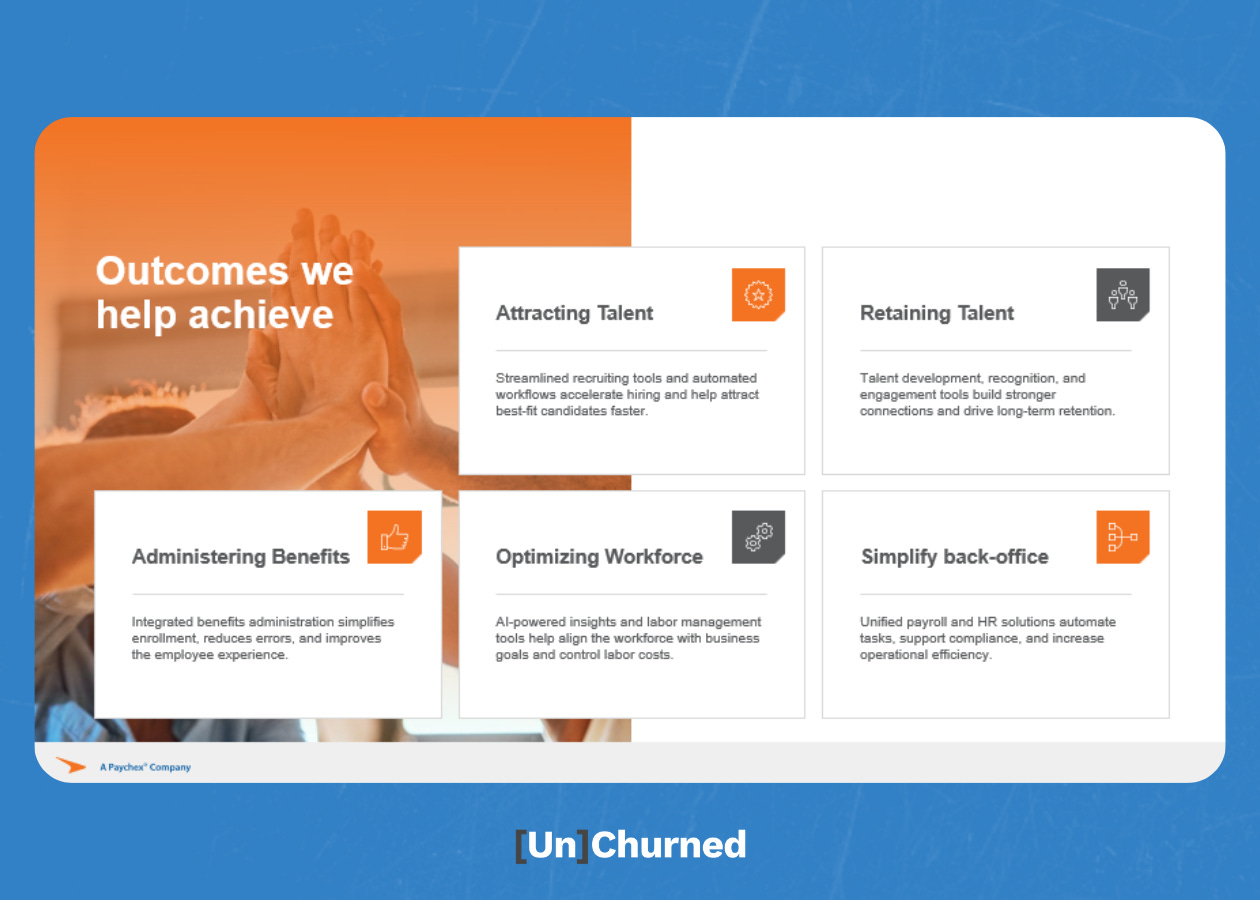
Each area connects to specific business outcomes and KPIs, making it easier to tailor conversations to what matters most to each customer.
Establishing the Metrics
To make the value framework actionable, each outcome area was paired with a defined set of metrics that help customers measure progress and validate results. These metrics give CSMs and customers a shared way to quantify success and anchor conversations in outcomes rather than activity. Here are some examples:
1. Attracting Talent
Number of applicants per role
Time to fill (often targeting a 30–40% reduction)
Offer acceptance rate
2. Retaining Talent
% of employees with completed development plans
Frequency of manager check-ins and 1:1s
Reduction in voluntary turnover
Employee Net Promoter Score (eNPS)
3. Administering Benefits
% of employees enrolled by enrollment deadline
Benefits participation and utilization rates
Time saved during open enrollment
4. Optimizing Workforce
Forecast accuracy (scheduled vs. actual labor)
Manager satisfaction with workforce planning tools
5. Simplifying Back Office
% of workflows automated
Admin and manager system usage rates
Payroll error rate
The value framework is embedded directly into Quarterly Business Reviews (QBRs), serving as the foundation for how CSMs structure the conversation—aligning on goals, tracking progress, and demonstrating measurable outcomes over time. These metrics also act as conversation starters, helping customers think more strategically about what success looks like and how to measure it.
“To help CSMs connect customer goals to tangible results, we partnered closely with our product team to map each outcome to the Paycor capabilities that enable it. For example, a customer focused on retaining top talent would align to talent development solutions, with success measured through improvements in engagement, retention, and employee growth.” - Alan Schaffer
This structure ensures that every QBR clearly connects three things: the customer’s stated goals, the actions taken, and the measurable impact achieved.
Growing Cross-Functional Alignment
Getting cross-functional agreement on the categories was a challenge in itself. When you’re building something that sellers, CSMs, solutions engineers, and learning teams all need to use consistently, you’re building a shared language. This requires the kind of multi-stakeholder interviews that most teams skip because they feel slow. Alan’s view: you can’t shortcut it. The consistency you get on the back end is only possible if you do the alignment work on the front end.
One of the biggest learnings was how much this work influenced teams beyond Customer Success. What started as a CS initiative quickly made its way upstream into the sales process. The value framework and success planning approach are now being introduced on prospect calls, to clearly outline the outcomes buyers can expect and the structured partnership they’ll receive post-sale.
“That wasn’t part of the original plan. We set out to improve how CSMs drive value after the sale, but it ended up reshaping how we position value before the deal is even closed.”
- Alan Schaffer
They were surprised at how powerful the alignment between Sales and CS became. Instead of Sales, CS, and customers having slightly different definitions of success, Paycor now has a shared language from the first conversation. It reinforces a simple idea early: Customer Success isn’t something that happens later. It’s the foundation of the partnership from day one.
How the Playbook Gets Used
With the playbook developed, it was time to set it in motion. It operates in a cyclical structure.
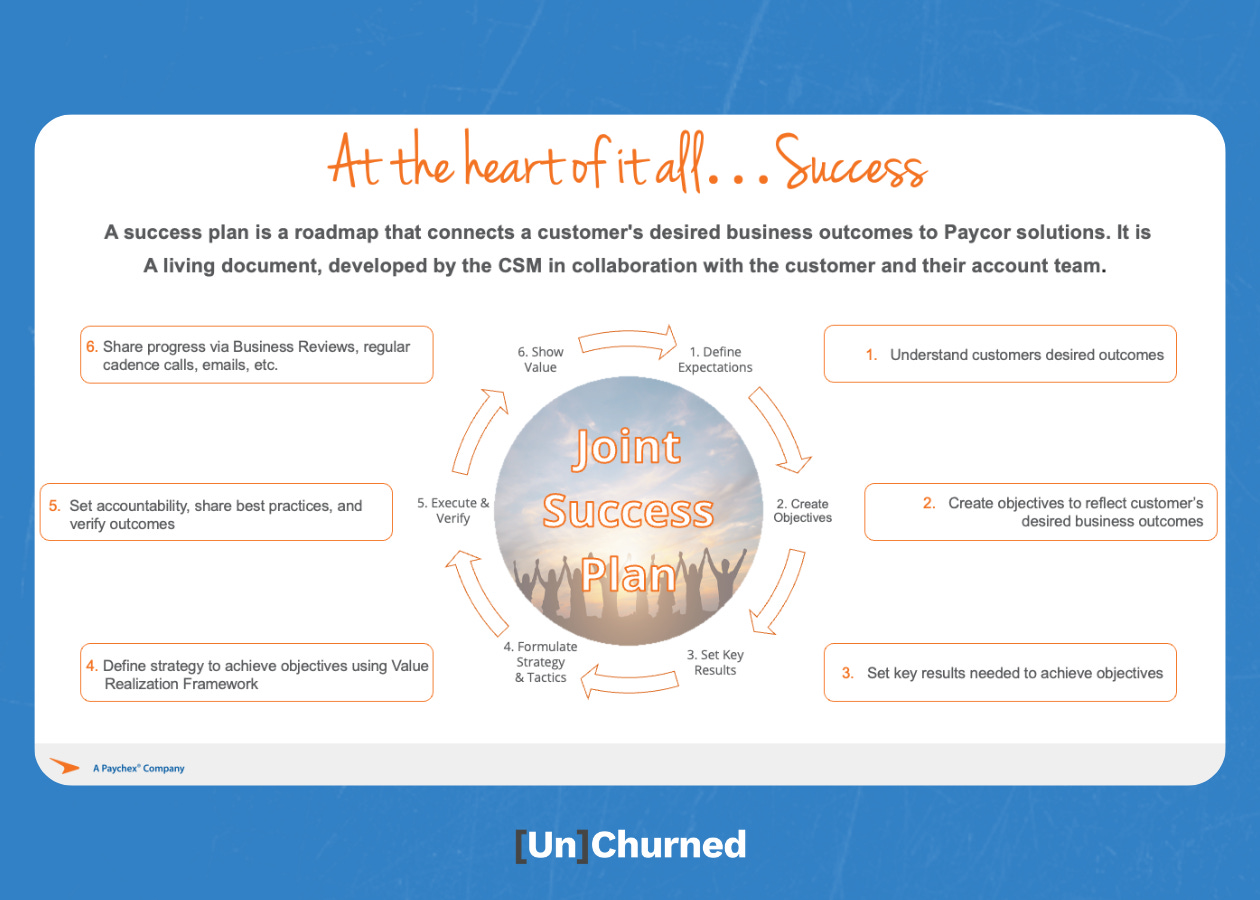
A CSM opens with a strategic conversation rooted in two open-ended questions:
What are your goals for the next six to twelve months?
What problems are you trying to solve?
Using the insights from that conversation, the CSM creates a success plan. This shared document connects customer goals to specific outcome categories, with metrics attached.
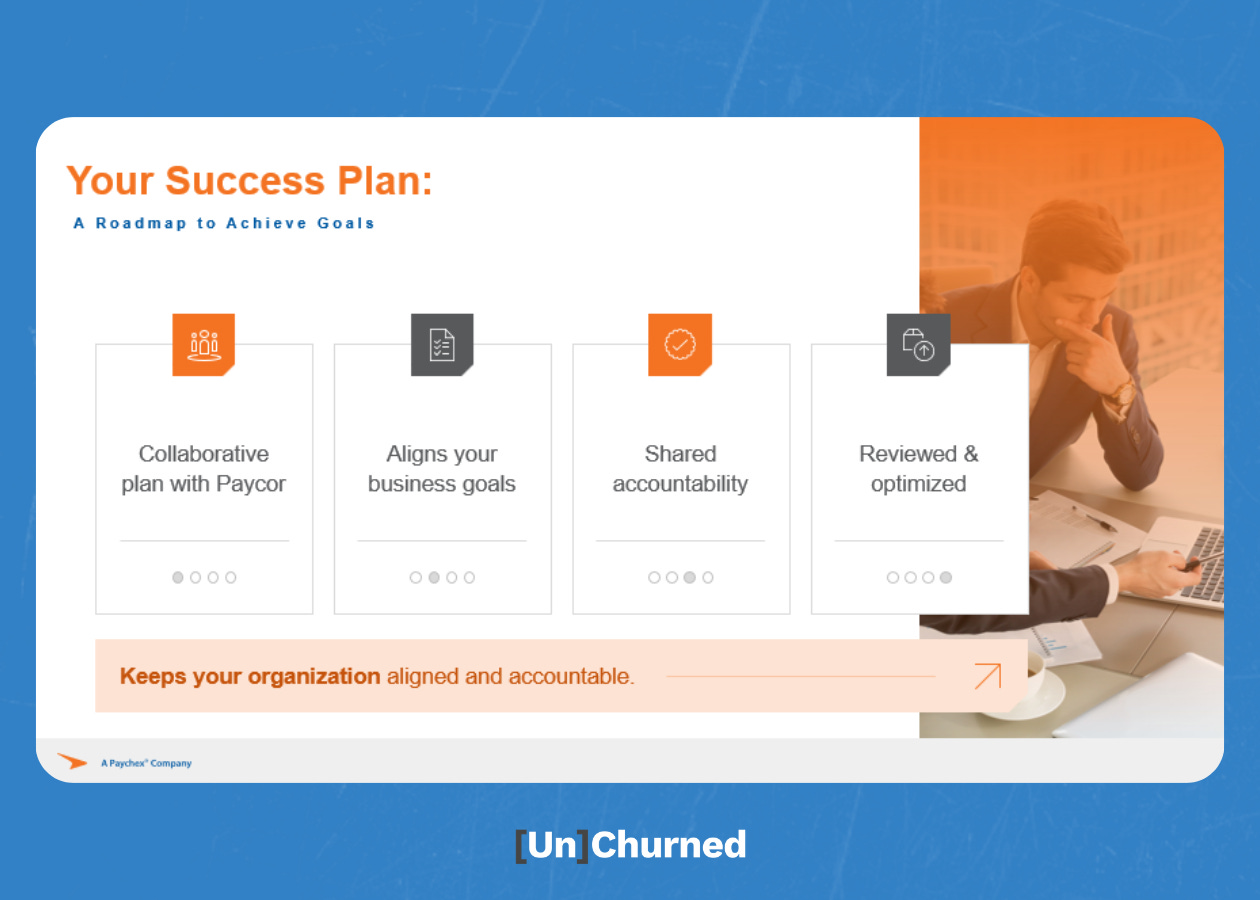
From there, the CSM becomes a curator. If a customer has flagged hiring velocity as a priority, they’re receiving relevant content, such as articles, webinars, and product guidance, specifically tied to that goal. Instead of generic Paycor communications, customers receive targeted communications that ladder up to their desired outcomes.
At the QBR the loop closes. The CSM comes back to what was agreed, shows what moved, and gets the customer to verify. “You mentioned you wanted to reduce your time-to-hire. Using this product, you cut it by 50%.” Once you’ve documented an outcome, you can reset and go again. New goals. New metrics. Another cycle.
One surprising outcome was the increased level of executive engagement. Paycor’s CSMs work primarily with payroll administrators, HR directors, and VP-level contacts. CHROs and CFOs aren’t usually in the room. But when the conversation shifts from “here’s what the platform can do” to “here’s the measurable improvement your organization achieved,” executives start showing up. The playbook created a reason for them to do so.
The Unexpected Win: Boosting Team Morale
The Human Capital Management (HCM) industry isn’t for the faint of heart. As Adnan describes it, it’s “relentless and thankless, especially at year-end.” Customers are under a lot of stress, issues come fast, and there is a constant pull toward reactive firefighting. The work left his team with no way to feel they were winning, and inevitably, burnout followed.
The value realization framework changed this energy completely. When CSMs have a clear idea of what strategic work looks like and the tools to have those conversations, they get back something they were missing: the feeling that they’re making progress. Alan calls it “a renewed sense of focus and energy.” Confidence went up and the stress of heroics went down.
Before launching, Adnan surveyed the team. The high-performing CSMs wanted this. Not because it made their jobs easier, but because it gave them a framework for the conversations they already thought they should be having. They wanted to be thought leaders for their customers, but never had the structure to do it.
That’s the piece that’s easy to miss when you think about value frameworks as customer-facing tools. The CSMs who’d been operating in a transactional mode were doing it because the work was set up that way. When you give them a defined path to something more strategic, the identity shift follows. How a customer sees their CSM changes. How the CSM sees themselves changes. Paycor went from being simply a vendor to a strategic partner, and the CSM was the champion leading the way.
Alan and Adnan made two investments that were critical to the overall success of their playbook rollout.
Investing in Enablement
Paycor worked with Bob London to teach CSMs how to ask questions that move the conversation from “let’s talk about your issues” to “let’s talk about your business.”
These enablement sessions reinforced a critical behavior shift: great customer conversations start with understanding, not solving. CSMs were trained to ask open-ended, strategic questions and resist the urge to immediately jump into solutions.
“As Nick Mehta once shared with my team, the greatest asset a CSM can have is to be curious. Ask questions to understand. For many on the team, this was a reset. It gave them permission to slow down, listen deeply, and focus on the customer’s broader business context instead of just product usage or immediate issues. As a result, conversations became more strategic, insights were richer, and CSMs felt more confident leading discussions with higher-level stakeholders.” - Adnan Rahman
This training was essential. The playbook showed CSMs what to discuss and the training made it actionable, showing them how to have impactful value conversations. If you want to hear Adnan expand on the curiosity mindset and what it actually takes to coach a team toward strategic conversations, check out his episode of the [Un]Churned podcast.
Investing in Talent Clarity
Once strategic work is defined, it’s easy to see who’s having those conversations and who isn’t. Coaching became more focused. Gong call reviews targeted the right moments. The playbook made it clear who was adapting to the new model and who wasn’t. Not everyone made the transition, but that clarity was valuable too.
Together, these investments ensured the playbook didn’t just exist on paper. The team had the skills to execute it and a clear picture of what execution actually looked like. With the human side of the rollout on solid footing, the question became, “How do you deliver this level of strategic engagement across tens of thousands of customer relationships?”
The Digital Layer
The next step is figuring out how to scale the value playbook through digital channels and AI-assisted outreach. With 30,000 relationships, not every customer can have a dedicated CSM.
As a customer moves through the sales cycle, key information about their goals and context follows them into the post-sale relationship. For customers without a CSM, AI-driven campaigns send targeted content based on their outcome categories using the same logic a CSM would use in a one-on-one conversation, but now at scale.
For customers with a CSM, digital campaigns work alongside the human relationship. As Alan says, it arrives “on a silver platter.” The CSM doesn’t have to search for context; it comes to them. Using Gainsight’s Journey Orchestrator, they’ve built signal-driven journeys based on key customer parameters. These journeys allow them to engage customers directly with targeted, outcome-aligned content, while simultaneously creating coordinated calls to action for CSMs.
Example 1: Maximize Growth Opportunities
These journeys identify customers at critical growth moments and deliver timely, value-added content, tailored support, and relevant expansion pathways. At the same time, Gainsight surfaces these signals to the CSM as a Call to Action (CTA), equipping them with the context they need to engage in a more strategic, informed way.
Example 2: Deliver Client Education
These journeys focus on client education to accelerate onboarding and time-to-value. New users are enrolled in targeted programs that deliver role-specific training and certification content, helping them get up to speed quickly and begin realizing value early in their lifecycle. CTAs are also sent to CSMs, prompting them to follow-up on new administrator certifications to ensure successful adoption.
Alan and Adnan built the playbook first, tested it with real CSMs, and are now using digital tools to scale what works. That’s the right way to do it. If you automate before you know what you’re delivering, you just get more volume, not more value.
Once You Define Value, You’re Accountable to It
The hard truth about building a playbook like this is that once it’s in place, you can’t ignore what it shows. You see which customers are having strategic conversations and which aren’t. You see which CSMs use the model and which are still reactive. You see which parts of the organization are aligned and which aren’t.
Paycor set out to solve a customer value problem. Along the way, they also solved a team clarity problem. The playbook didn’t just change how CSMs talk to customers, it changed how leaders can see, develop, and hold the CS team accountable for more than just managing tickets.
That’s what this kind of initiative really asks: be willing to see what you build. Not every organization is ready for that. But organizations that are ready often find their CSMs were ready all along.
About This Article
This article draws from a detailed conversation with Adnan Rahman, Head of Customer and Partner Success, and Alan Schaffer, Sr. Manager of Customer Enablement, both at Paycor, on how they developed a value realization framework that changed both customer outcomes and team morale on Paycor’s CS organization.
Adnan also joined the [Un]Churned podcast to talk through how CS teams can lead with business outcomes, and what it actually takes to make that shift stick. Check out his episode, here.
All data referenced here has been sanitized to protect confidential business information.