![[Un]Churned by Gainsight](https://substackcdn.com/image/fetch/$s_!7AoO!,w_120,h_120,c_fill,f_webp,q_auto:good,fl_progressive:steep/https%3A%2F%2Fsubstack-post-media.s3.amazonaws.com%2Fpublic%2Fimages%2Ffe2167ac-0bcf-4575-9712-8d5ef3588851_300x300.png)
![[Un]Churned by Gainsight](https://substackcdn.com/image/fetch/$s_!hKlf!,e_trim:10:white/e_trim:10:transparent/h_72,c_limit,f_auto,q_auto:good,fl_progressive:steep/https%3A%2F%2Fsubstack-post-media.s3.amazonaws.com%2Fpublic%2Fimages%2Fe14b36dd-52b9-48a3-9f93-3f6a459d55ff_1344x256.png)
![[Un]Churned's avatar](https://substackcdn.com/image/fetch/$s_!vkJ0!,w_108,h_108,c_fill,f_webp,q_auto:good,fl_progressive:steep/https%3A%2F%2Fsubstack-post-media.s3.amazonaws.com%2Fpublic%2Fimages%2F0464ad30-26c2-4f32-b429-ae4283dd5586_200x200.png)

This week was a reminder that AI doesn’t magically fix Customer Success, it just makes the good systems scale faster and the broken ones harder to ignore.
Here’s what’s been on my mind this week.
(This Week’s [Un]Churned 🎙️)
Episode 163: 18 Months, 7,000 Customers, 67% Support Resolution: Inside Intercom’s FDE Strategy ft. Diego Ballona
This week on [Un]Churned, I sat down with Diego Ballona, who leads Intercom’s Forward Deployed Engineering team. In 18 months, his group built a system that now resolves 67% of support questions before they ever reach a human, across roughly 7,000 customers.
While the stat is impressive, it’s not even the most interesting part.
What made this conversation worth lingering on was how deliberately unglamorous the work was. Diego didn’t describe a breakthrough moment or a big-bang AI rollout. He described a series of choices about where not to intervene, which questions weren’t worth automating yet, and how much ambiguity the team was willing to tolerate while learning what customers actually needed at the front door.
A lot of support leaders talk about being customer-centric. Diego talked about being sequence-centric. What information should exist before a customer asks for help? What should be answered without context? Where does automation help, and where does it just move the problem downstream?
We also spent time on a tension that most execs feel but rarely name clearly: efficiency versus trust. Diego’s take was refreshingly pragmatic: automation isn’t there to replace humans; it’s there to earn the right not to involve them. When that framing is clear, the trade-offs become easier to make and easier to defend internally.
Think of this episode as a field report from a team that treated support like a product surface, not a cost center. If you’re scaling a company and wondering how much of your support load should exist before a ticket is ever filed, this is a model worth studying.
Building in Public (and Being Wrong First)
Earlier this week, I shared a post on that was a little more candid than usual. Not because it was provocative, but because it admitted something that’s uncomfortable to say as a leader: I thought we understood our own Customer Success process. We didn’t.
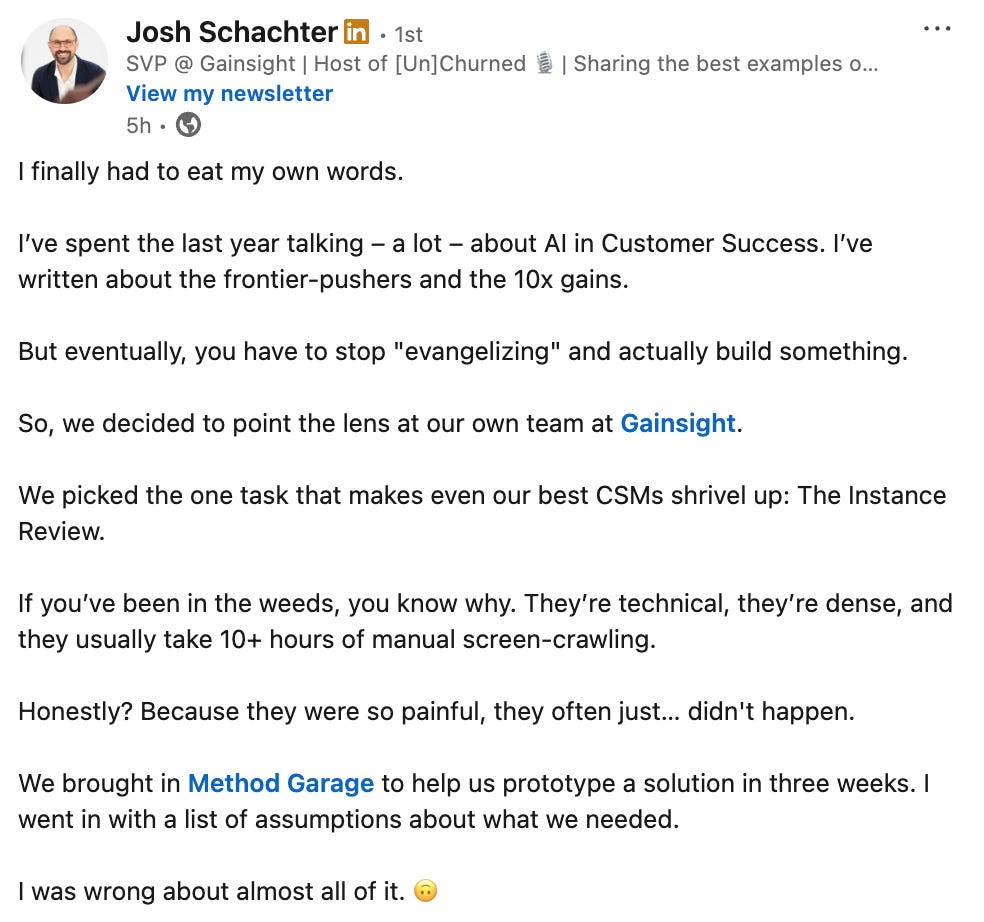
That post was a preview of a deeper piece we just published with Saul Gurdus at Method Garage, where we turned the lens inward on one of the most valuable yet avoided CSM motions: the Instance Review. What I assumed was an AI problem turned out to be something else entirely: a capability gap hidden behind years of workarounds and tribal knowledge.
In the article, I walk through what actually mattered in the Blueprint phase. Finding the one person who had already cracked the problem manually. Letting go of the idea that we needed perfect data to start. And realizing that the real ROI of AI is finally being able to do the high-value work that’s been avoided because it was too hard.
ICYMI: Three [Un]Churned Episodes Worth Adding to Your Queue
With a long weekend for some of you, I wanted to resurface some recent UnChurned episodes. They’re less about trends and more about the structural decisions that actually move retention, scale, and leverage.
Ep. 161 — Stop Managing 38% of Your Customers
ft. Yvette Hill Smith (F5)
In this episode, Yvette makes a compelling case for something most CS orgs resist: intentionally not managing a meaningful portion of their customer base. We unpack how over-coverage quietly drains teams, why segmentation often fails in practice, and what it really takes to let go without putting retention at risk. If your team feels stretched no matter how many CSMs you add, this one hits close to home.
Ep. 159 — The #1 Thing Great CCOs Do in Year One
ft. Alexis Hennessy (Heidrick & Struggles)
This conversation is a reality check for anyone stepping into a Chief Customer Officer role. Alexis breaks down what the strongest first-year CCOs actually do (and it’s not launching sweeping transformations). They narrow the field, establish clarity, and resist the pressure to fix everything at once. If you’re inheriting a messy org and feeling the clock ticking, this episode offers a calmer, more disciplined blueprint for earning credibility early.
Ep. 158 — How Community Increases Retention 4x
ft. Erica Kuhl (Gainsight)
Community often gets positioned as a “nice-to-have.” Erica breaks down why that framing is wrong and how community becomes a force multiplier for retention when it’s treated as infrastructure, not a side project. We dig into where community actually shows up in the customer journey and how it changes the economics of CS at scale.
Wrapping Up
The good scales when you design for sequence and ownership. The bad shows up when work is fragmented and avoided. And AI doesn’t change the equation, it just accelerates the outcome. The teams that win won’t be the ones with the flashiest tools. They’ll be the ones willing to redesign the work itself.
See you next Monday 🧠
🌱 Josh
SVP, Strategy & Market Development @ Gainsight

👋 Connect with me on LinkedIn
🎧 Listen to more episodes of [Un]Churned