![[Un]Churned by Gainsight](https://substackcdn.com/image/fetch/$s_!7AoO!,w_120,h_120,c_fill,f_webp,q_auto:good,fl_progressive:steep/https%3A%2F%2Fsubstack-post-media.s3.amazonaws.com%2Fpublic%2Fimages%2Ffe2167ac-0bcf-4575-9712-8d5ef3588851_300x300.png)
![[Un]Churned by Gainsight](https://substackcdn.com/image/fetch/$s_!hKlf!,e_trim:10:white/e_trim:10:transparent/h_72,c_limit,f_auto,q_auto:good,fl_progressive:steep/https%3A%2F%2Fsubstack-post-media.s3.amazonaws.com%2Fpublic%2Fimages%2Fe14b36dd-52b9-48a3-9f93-3f6a459d55ff_1344x256.png)
![[Un]Churned's avatar](https://substackcdn.com/image/fetch/$s_!vkJ0!,w_108,h_108,c_fill,f_webp,q_auto:good,fl_progressive:steep/https%3A%2F%2Fsubstack-post-media.s3.amazonaws.com%2Fpublic%2Fimages%2F0464ad30-26c2-4f32-b429-ae4283dd5586_200x200.png)
Customer Success is becoming an outcome business. The venture capital world has reached the same conclusion, and they’re betting billions on it.
Here’s what’s on our minds this week.
🎙️Betting That Human Engagement Is the Competitive Edge
Cassie Vaughn is the RVP of Customer Success at monday.com and a serious F1 fan. Ask her about the sport, and she’ll tell you the pit stop is more science than spectacle. It looks like chaos from the outside, but every movement is rehearsed and every role is defined.
It’s a metaphor that maps surprisingly well to how she runs her CS org. This year, her team is deploying agents to handle discovery, optimization, and workflow builds, while committing high-touch CSMs to spending double the time with customers compared to last year. The agents run the repeatable work. The CSMs show up on-site, whiteboard customer workflows end-to-end, and help executives think through what their processes look like in two years when AI removes half the steps. It’s disciplined, deliberate, and entirely by design.
For CS leaders, it’s worth pressure-testing against your own org. When agents take the repeatable work off your team’s plates, where does that time go? You can add more accounts to their book of business, or take a page from Cassie’s book and dive deeper into the accounts that matter most.
Here’s the Full Episode:
Hear the full episode right here or on your favorite podcast app, and listen for these two things:
Why Cassie doesn’t trust health scores and what she coaches her team to do instead.
The case she made internally to tie CSM compensation to retention outcomes, and what it took to get leadership buy-in.
Join Us at Pulse 2026
The conversation doesn’t stop here. Pulse 2026 is where CS and revenue leaders come together in Las Vegas this May to work through exactly these questions. Register now using the code “UNCHURNED” for a special rate.
🎯 The [Un]Churned Take: Information Is Table Stakes. Execution Is the Value.
The outcome-focused CS conversation has been building for a while, and a few recent posts make it easier to see where it’s actually headed.
SaaStr founder Jason Lemkin recently shared that his AI agent sent 150 fully personalized sponsor update emails in a single morning, each with unique task lists, links, and action items for every account. His take was that the agent outperforms most human CSMs at the operational layer. Not because CSMs aren’t good at it, but because that kind of coverage, at that level of specificity, is just not physically possible for a human at scale.
The VC world is arriving at the same place from a different direction. Sequoia, a16z, General Catalyst, and Founders Fund are all converging on a thesis that the next wave of value isn’t in selling software. It’s in selling the work itself.
CS teams are good at finding answers. They’re delivering decks, holding QBRs, and sharing recommendations. But, the real value is in turning customers into operators. If agents handle what’s repeatable, CSMs are free to make judgements, strengthen relationships, and be strategic.
As a result, CSMs are navigating more change at once than at any other point in the function’s history. Their role is being augmented, their metrics are shifting, and they're being asked to build commercial and strategic skills on top of it all. An agent can handle the operational layer, but it can't build trust. If CSMs aren't supported through this transition, customers will feel it. Josh Schachter shared a real example on LinkedIn recently.
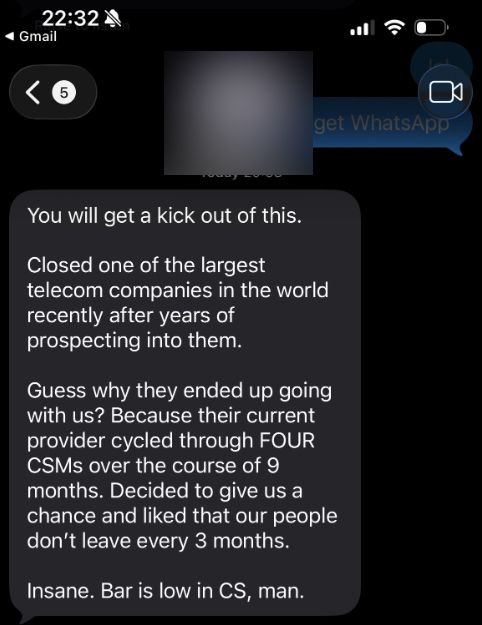
His colleague closed one of the largest telecom companies in the world after years of prospecting, because their previous vendor cycled through CSMs every few months and never got them to value. The win happened because CS failed at the other company. That’s the commercial consequence of getting this wrong.
The operational layer is being automated, and the strategic layer is up for grabs. The CS orgs that move first will define the role for the next decade.
☕ Off Topic: What Else We’re Reading
We’ve had years to test and explore what AI can do, but we’ve reached a point where AI needs to transform from a “cool demo” to true business value. These are four trends to keep in mind as the focus shifts from flashy pilots to scalable systems that deliver measurable outcomes.
Wrapping Up
Outcomes don’t build themselves. The orgs that get this right will be the ones that take the human side of this transition just as seriously as the technology.
See you next Tuesday 🧠