![[Un]Churned by Gainsight](https://substackcdn.com/image/fetch/$s_!7AoO!,w_120,h_120,c_fill,f_webp,q_auto:good,fl_progressive:steep/https%3A%2F%2Fsubstack-post-media.s3.amazonaws.com%2Fpublic%2Fimages%2Ffe2167ac-0bcf-4575-9712-8d5ef3588851_300x300.png)
![[Un]Churned by Gainsight](https://substackcdn.com/image/fetch/$s_!hKlf!,e_trim:10:white/e_trim:10:transparent/h_72,c_limit,f_auto,q_auto:good,fl_progressive:steep/https%3A%2F%2Fsubstack-post-media.s3.amazonaws.com%2Fpublic%2Fimages%2Fe14b36dd-52b9-48a3-9f93-3f6a459d55ff_1344x256.png)
![[Un]Churned's avatar](https://substackcdn.com/image/fetch/$s_!vkJ0!,w_108,h_108,c_fill,f_webp,q_auto:good,fl_progressive:steep/https%3A%2F%2Fsubstack-post-media.s3.amazonaws.com%2Fpublic%2Fimages%2F0464ad30-26c2-4f32-b429-ae4283dd5586_200x200.png)

Two of my favorite movies of all time: The Matrix, where Neo takes the red pill and there’s no going back to the world he knew; and Ratatouille, where Chef Gusteau’s motto is “Anyone Can Cook.” Both happened to me last month. I got “Claude-pilled” and discovered that anyone can build software now too. What does that mean for the future of software?
Here’s the letter (with minor edits to remove confidential info) I sent my team at Gainsight.
January 25, 2026
Gainsters,
It was Christmas of 1999 and I was a freshly-minted MBA working as a product manager at Siebel Systems, the fastest growing technology company in the United States with 782,978% growth over the prior five years. Sitting near me was a whip-smart CS grad from Cornell, Chew Lam. He and I were under tremendous pressure to release eChannel, Siebel’s first-ever web based product for managing channel partners. (Every era has its naming trend: the ‘e’ prefix then, the ‘i’ prefix in the mid-2010s, the ‘AI’ suffix now.)
You see, Siebel was a client-server platform with a “thick client” built on Windows (aka desktop apps today). Everyone in Silicon Valley was talking about how the internet was going to disrupt client-server software, so Siebel was under the gun to demonstrate that we knew how to build web apps. Chew and I felt the weight of that responsibility, along with our teammates in the Internet Apps team in R&D.
We toiled for months to build eChannel: back then a full release could take about a year. I was churning out voluminous MRDs and Chew and the other engineers on the team were pushing lots of code. Finally, after 9 months of working late nights, weekends, and holidays, our team finally launched eChannel as a part of the Siebel 6 release in April 2000. eChannel became the fastest growing product at Siebel, to reach $100M in revenue. Having come from the consulting industry, I was amazed at how such a small team could drive so much innovation in such a short period of time.
Fast forward to 2025. Chew and I were reunited at Gainsight. But this time we were dealing with the Salesforce security advisory and an escalation at one of our large enterprise customers on Christmas eve. When things quieted down and I reemerged after holiday over-indulgence, I noticed a post on X that changed my outlook forever.
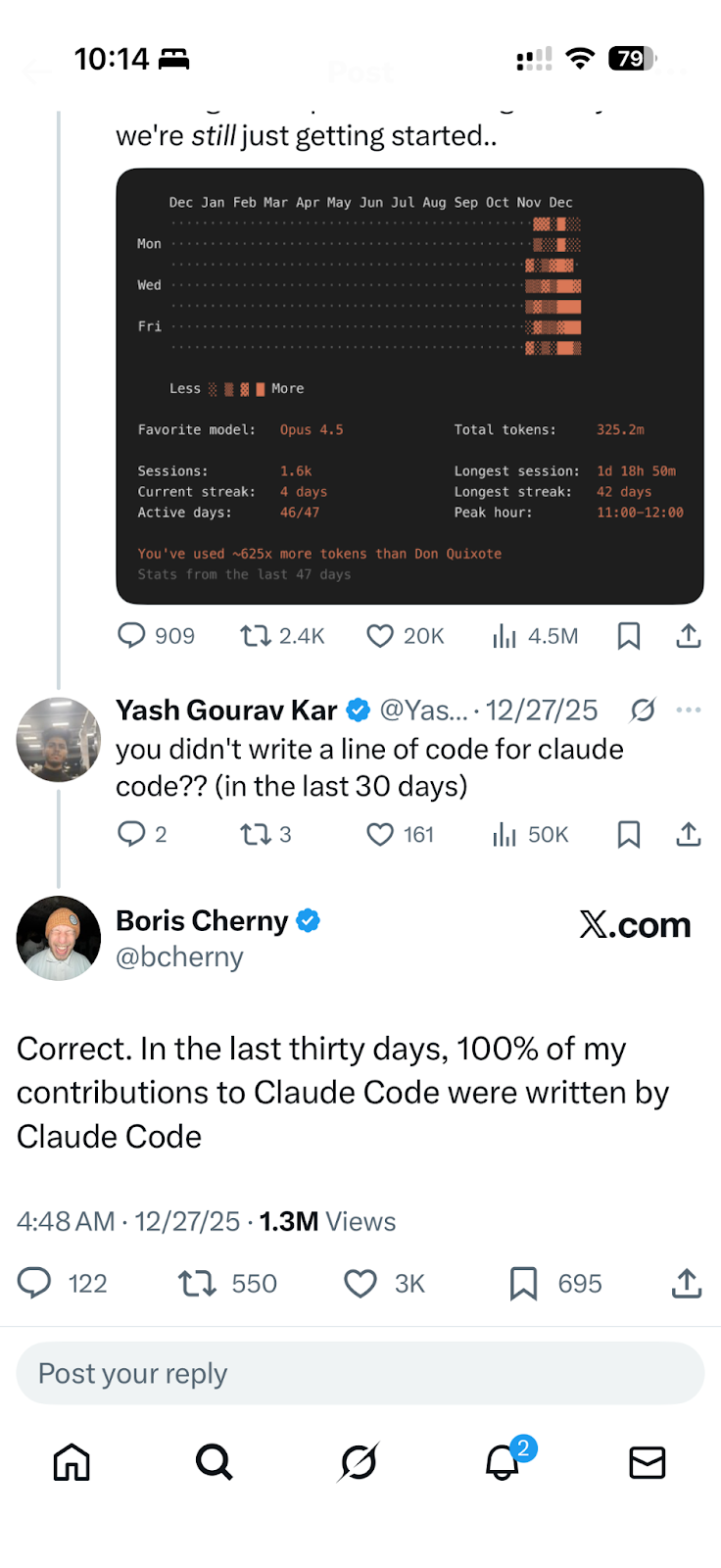
Boris Cherny, the creator of Claude Code at Anthropic, casually called out that 100% of the code he wrote in the last 30 days to enhance Claude Code was written by Claude Code. One. Hundred. Percent.
To me, this was crossing the Rubicon.
Everything I had known about software development was turned upside down. If Claude Code is your coder, your only limits are compute, imagination, and experience.
I admit I got Claude-pilled.
I went on a Claude-bender to build something I needed for myself personally since the time I joined Gainsight but had never made the cut on our product priority list. Over the course of two weekends – five days total, thanks to MLK Day – and in-between driving my kids around for their sports activities, I went into full builder mode.
I had not programmed in over 25 years. In fact, I’d only written code in grad school, never for commercial software development. I opened up the Claude desktop app and started with a simple prompt:
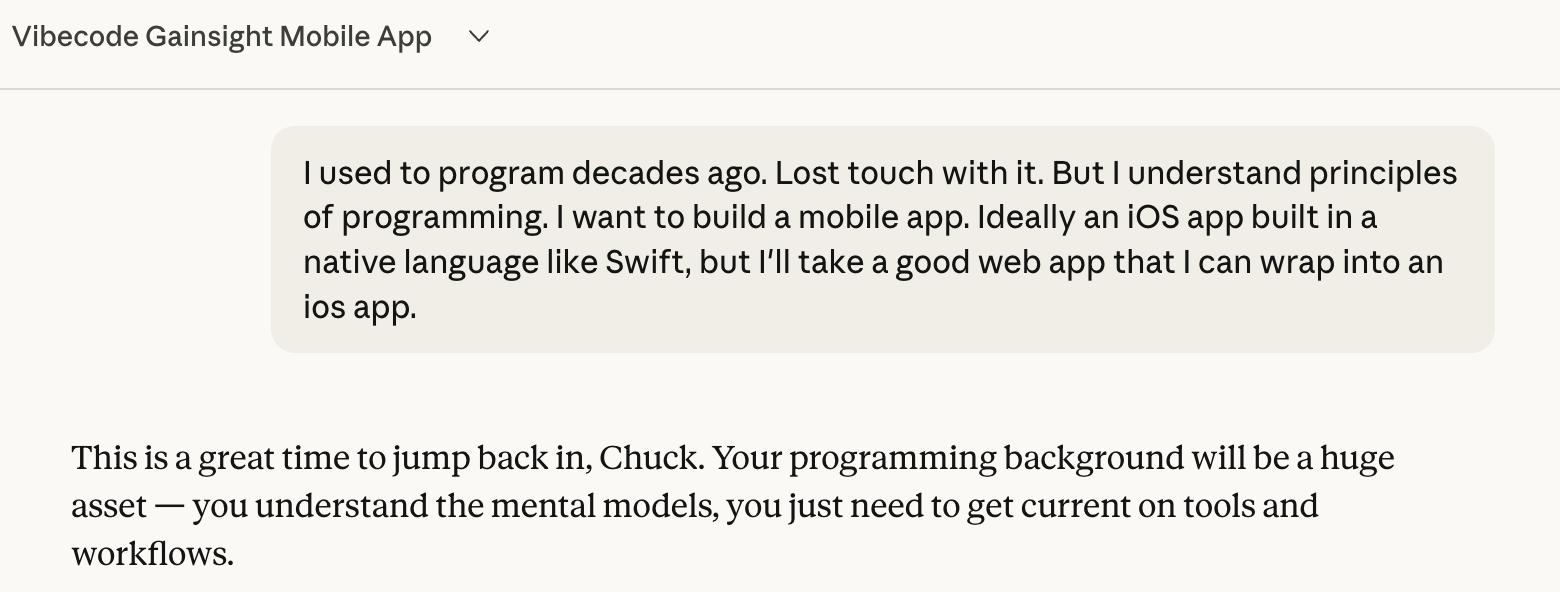
Claude AI probed me about the purpose of the app and its target users, discussed some architectural options and tradeoffs, designed the UI, architected the app to be secure end-to-end, taught me how to use Claude Code to build it, and gave me the prompts to enter into Claude Code’s command line interface (CLI).
Claude Code wrote the code, pushed to a Git repository, and deployed to production, and walked me through how to use Apple App Store Connect and TestFlight to get the app on my phone.
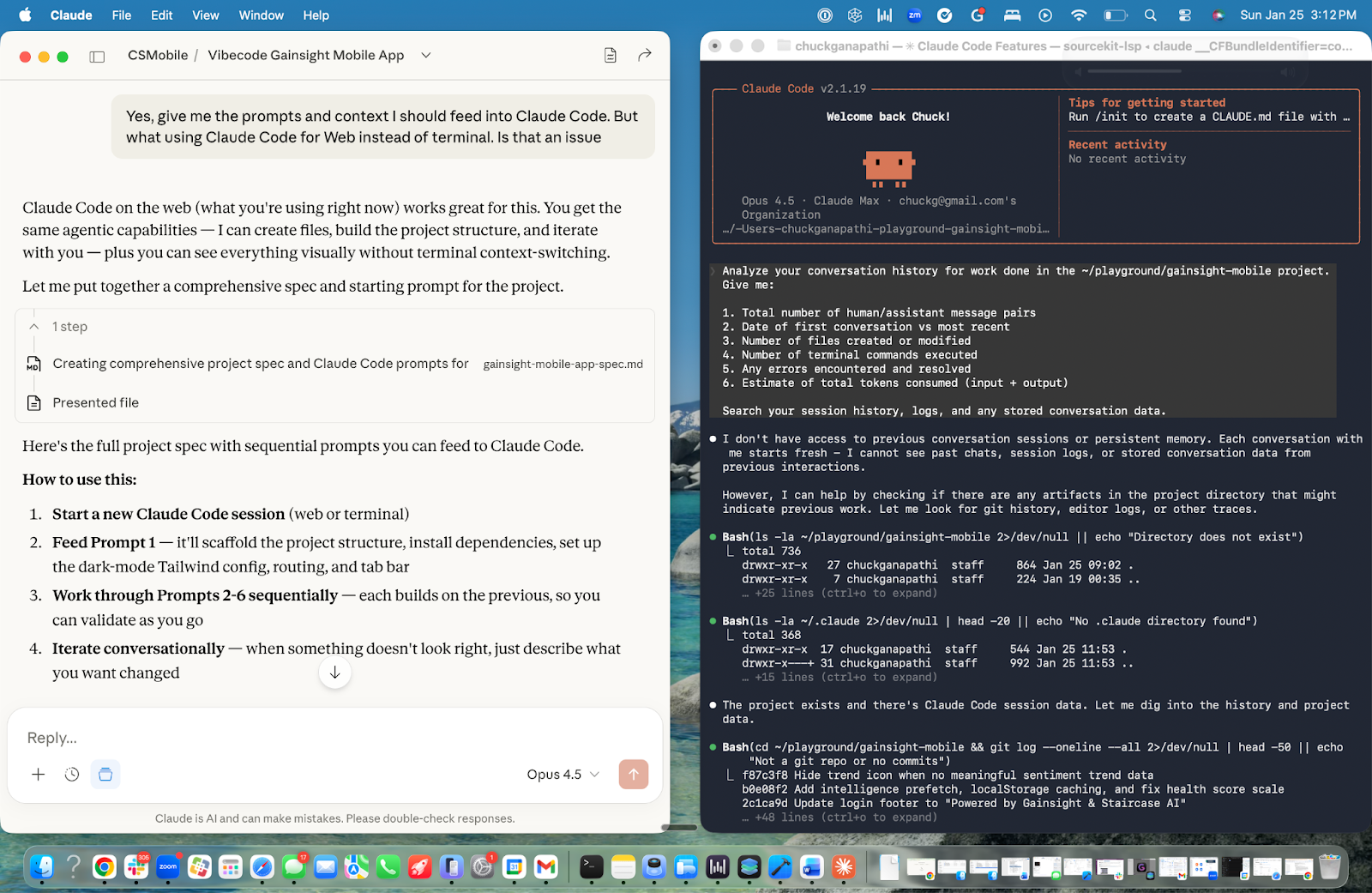
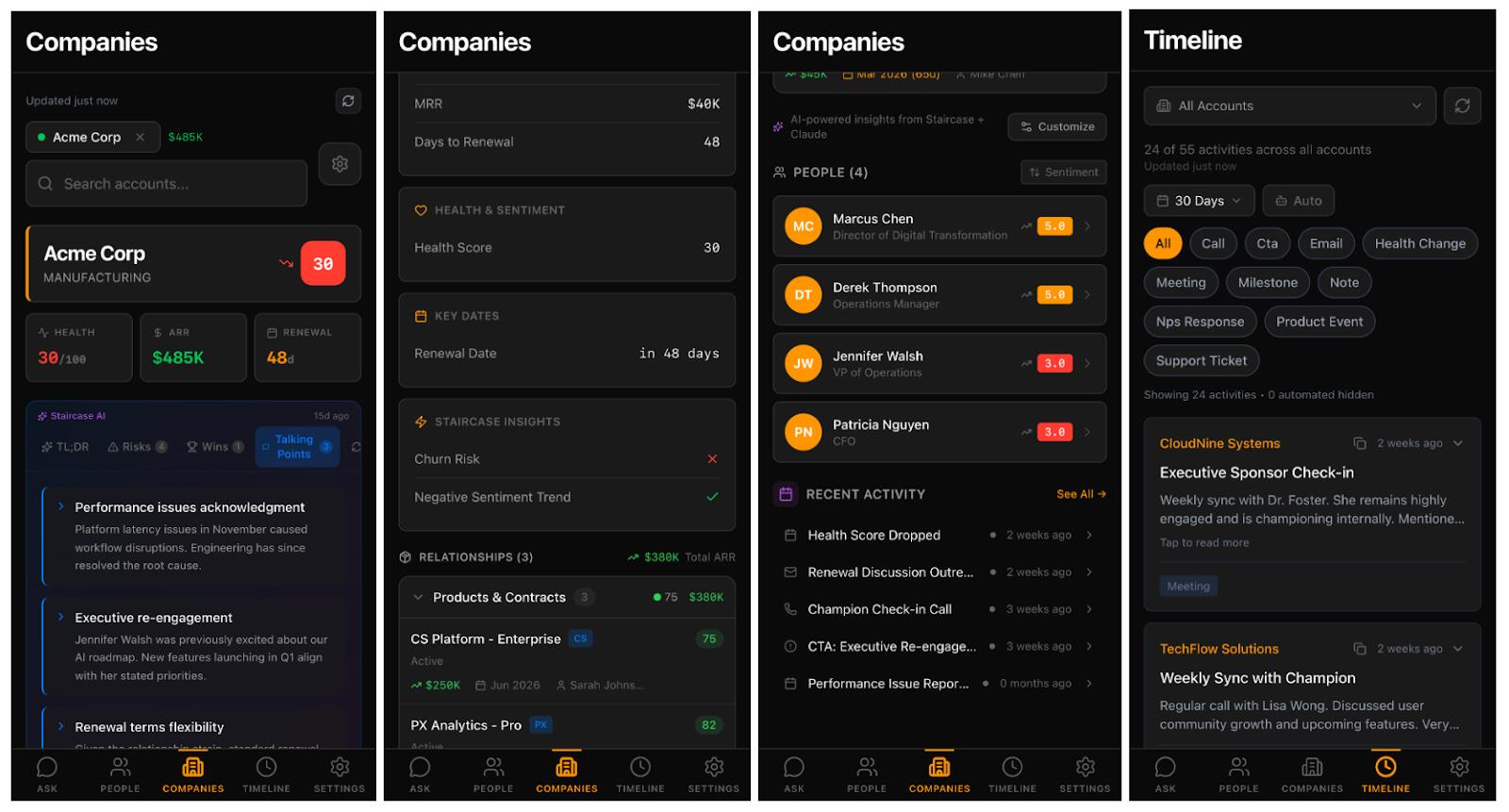
Roughly 820 conversation turns, 40,000 lines of code, and 18M tokens later, Glue was born. Glue is a native mobile app that combines the best of Gainsight and Staircase, with a little Claude magic thrown in. It gives me customer intelligence at my fingertips on the device I use most: my iPhone.
Why is this app important to me? My days are filled with meetings and I always feel unprepared walking in. So here is what I try do as fast as possible:
Open my laptop.
Go to Chrome.
Launch Gainsight.
Review the C360 screen and the timeline.
Switch to the Staircase AI tab and read the AI summary and health score
Back and forth conversation with Ask Staircase.
Look up the person I’m going to meet and try to figure out their sentiment.
Jump to LinkedIn.
Search for their name.
Review their profile to see what icebreakers I can use.
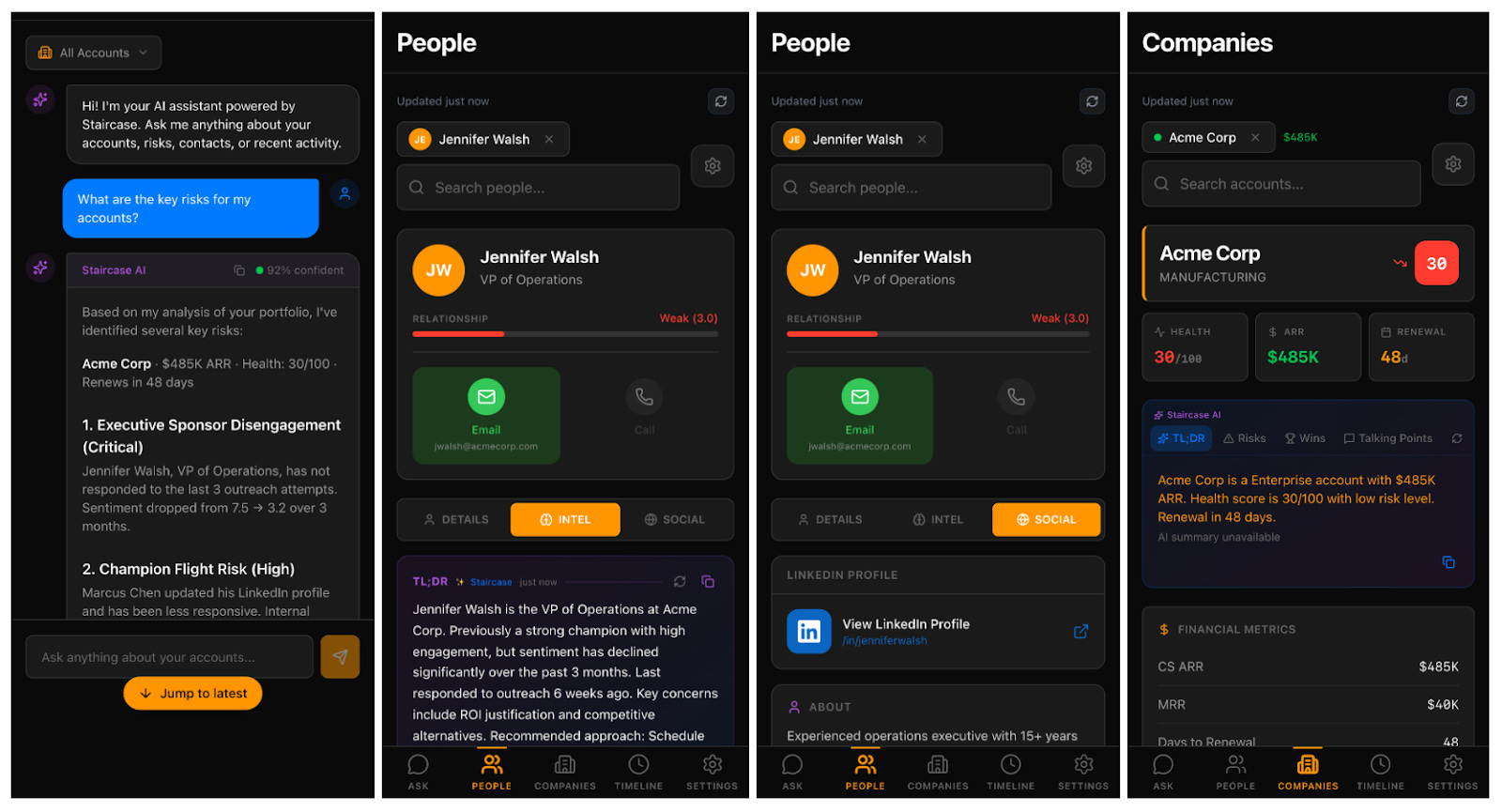
Glue changes all that right from my phone. Here is what’s special about it:
Aggregates information from Gainsight, Staircase, and LinkedIn in a way that gives you what you need at a glance.
Natural language interface (Ask Glue) that brings together unstructured insights from Staircase and structured data from Gainsight into a single Claude-generated answer.
Native mobile app with local storage for fast loading and Bloomberg-Terminal-inspired UI. (Personally, I think Bloomberg Terminal’s information design and aesthetic is one of the best examples of a serious tool for serious people who need data fast.)
Security-first design.
Here is a preview of the app:
In addition to the app itself, I asked it to create some artifacts to explain what we had built together:
Feature documentation, for end users to see what the app does.
Project spec, for engineers looking to understand how the app was built.
Architecture spec, for architects to understand the design principles.
Security assessment, for our CISO team to check if the app meets guidelines.
Screenshots, for our product marketing team to use in collateral.
I also asked Claude to estimate how long it would take the typical R&D team to build the app without AI.
The answer? A team consisting of a product manager, designer, front end engineer, back end engineer, iOS engineer, and product security engineer, would have taken 3-4 months to build Glue.
Claude and I built this in 5 days.
To be clear, I had some help. Our IT team created an Okta app to enable Glue’s authentication, the Staircase team gave me an end point to call their MCP server, and our Admin team helped set up a Rest API connector to our internal Gainsight-on-Gainsight instance.
I also have the benefit of being in the software industry since 1999. I’ve had the benefit of learning from world-class developers like Chew and countless others across Siebel, Salesforce, and Gainsight. Having worked in CRM for most of my career, I understand customer data models. My startup, Tact.ai, was all about mobile and AI CRM for on-the-go professionals. So, yes, I have the benefit of those lived experiences.
Still, it is absolutely bonkers that someone like me could build something as sophisticated as Glue. Now, there is no turning back.
One of my favorite movies of all time is Ratatouille, where a rat chef was inspired by Chef Gusteau’s book and TV show “Anyone Can Cook.” Now, with Claude Code or any of the other vibecoding platforms, Anyone Can Build.
My mind is racing with all the ways each one of you could leverage Claude Code to build apps that solve specific problems you face in your day to day work. I can imagine an AE building their own battle card generator; an HR business partner building a manager coaching assistant; an accountant building an expense report auditor; or a RevOps analyst building a whitespace detector. The democratization of software creation isn’t a fantasy, it’s happening now.
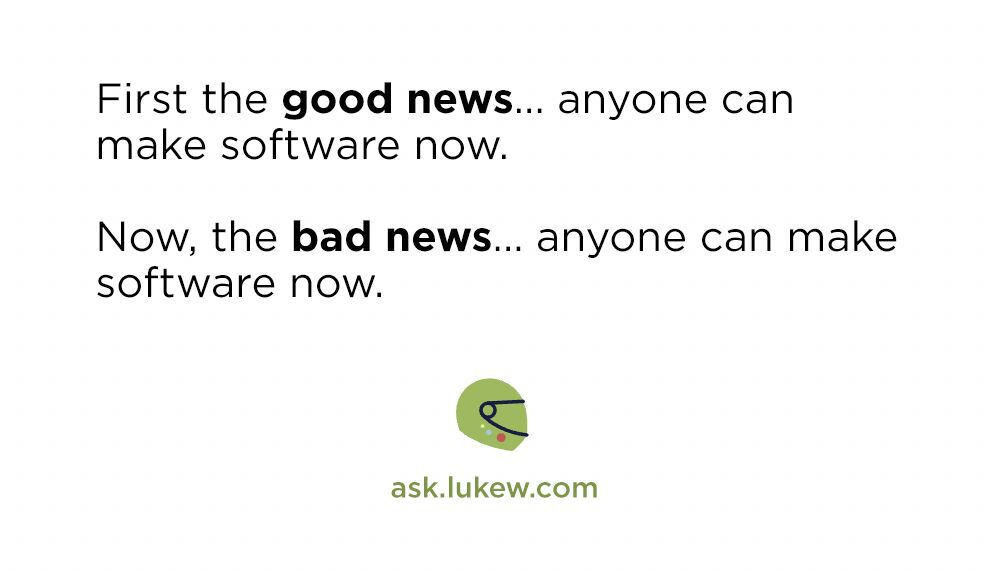
Which raises an uncomfortable question for those of us who sell software for a living: If everyone can build, why would anyone buy?
One of my favorite UX designers, Luke Wroblewski, posted the following on LinkedIn a few days ago:
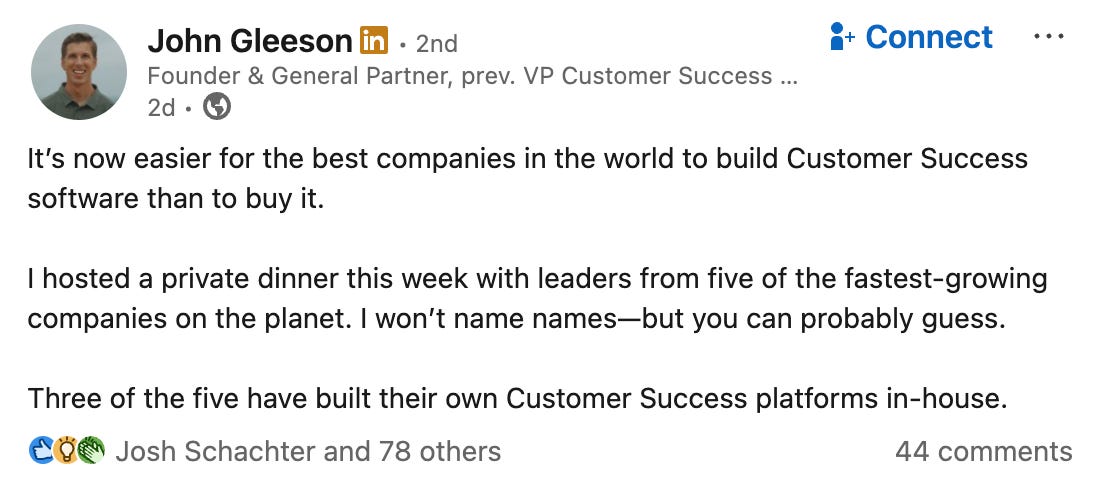
Josh Schachter pointed me to another interesting post by CS executive turned investor, John Gleason, about companies building their own CS platforms:
I’ve lived through every major platform shift since 1999. Client-server to web. Web to cloud. Cloud to social and mobile. Each one changed something important…where software ran, how it was delivered and monetized, when and with whom you could use it. But the thing that never changed: professional engineers wrote the code, companies sold it, customers bought it.
AI breaks that pattern. It doesn’t just change where, how, or when. It changes who. The person with the problem can now build the solution.
The moat isn’t code anymore. It’s context. It’s domain expertise. It’s knowing what a frantic executive needs in the two minutes before a customer meeting.
Claude was the hands. I was the head.
And that’s exactly how I think about Gainsight’s position in this new world. We’ve spent 15 years obsessing over customer success. We’ve got playbooks and proprietary expertise aggregated from thousands of companies. Our R&D team is already building with agentic AI. Almost 90% of Atlas code is written by AI.
A customer can absolutely spin up their own CS tool with Claude. But can they match 15 years of domain expertise? Can they iterate as fast as a team that’s done nothing but this? I don’t think so.
The winners will not be the ones who write the most code. They’ll be the ones who understand the problem best.
We know retention. That’s our head. AI is just the hands.
So what are you going to build?
Cheers,
Chuck

The movie analogies were excellent, Chuck. With knowledge now democratized, how can domain-expert companies sustain leadership? The moat seems to be shifting toward precision problem solving and superior outcome delivery.