![[Un]Churned by Gainsight](https://substackcdn.com/image/fetch/$s_!7AoO!,w_120,h_120,c_fill,f_webp,q_auto:good,fl_progressive:steep/https%3A%2F%2Fsubstack-post-media.s3.amazonaws.com%2Fpublic%2Fimages%2Ffe2167ac-0bcf-4575-9712-8d5ef3588851_300x300.png)
![[Un]Churned by Gainsight](https://substackcdn.com/image/fetch/$s_!hKlf!,e_trim:10:white/e_trim:10:transparent/h_72,c_limit,f_auto,q_auto:good,fl_progressive:steep/https%3A%2F%2Fsubstack-post-media.s3.amazonaws.com%2Fpublic%2Fimages%2Fe14b36dd-52b9-48a3-9f93-3f6a459d55ff_1344x256.png)
![[Un]Churned's avatar](https://substackcdn.com/image/fetch/$s_!vkJ0!,w_108,h_108,c_fill,f_webp,q_auto:good,fl_progressive:steep/https%3A%2F%2Fsubstack-post-media.s3.amazonaws.com%2Fpublic%2Fimages%2F0464ad30-26c2-4f32-b429-ae4283dd5586_200x200.png)

Most of the Customer Success (CS) leaders I talk to want to “do something with AI.” What they usually mean is, “I’m worried I’m already behind, but I don’t know where to start.”
While this anxiety is valid (and something I’ve also experienced), it can make you vulnerable to thinking the loudest idea is the highest priority.
Big AI projects like predictive renewals, autonomous playbooks, and automated customer engagement are exciting at first. In brainstorming, they sound like they’ll supercharge your team. But in reality, they’re tough to implement, costly to test, and risky to launch.
Often the most effective starting point for AI in Customer Success isn’t ambitious, but simple.
Start with a copilot. Think of an AI copilot as your AI-powered assistant. It helps your team work smarter by streamlining workflows and supporting the tasks they already do each day. These tools use large language models (LLMs) to create, summarize, and analyze content across data sources.
It’s low-risk, internal, and delivers immediate value to the team. You can start small, evolve gradually, and build on familiar platforms instead of buying new ones. Most importantly, it forces your team to organize its knowledge and learn to work with AI, not against it.
That’s exactly what Ankit Aggarwal, Sr. Manager of Customer Success Operations, did at MoEngage.
The Cost of Not Knowing Where to Look
When I first heard Ankit describe his team’s challenge, it sounded painfully familiar. MoEngage had grown to over 150 people in its CS organization, including CSMs, Professional Services, and Operations.
Regardless of the region, industry, or maturity level, they were all losing time to the same problem: finding answers.
CSMs spent hours digging through Confluence, Salesforce, and Zendesk to piece together customer information or product documentation. The same questions kept surfacing in Slack. Senior CSMs were often pulled into DMs to explain a process or troubleshoot an issue they’d already solved many times before.
The knowledge existed, but the issue was access.
As MoEngage’s CS team grew, so did this problem of finding the right answers. But the solution was forming too. MoEngage had recently created an internal AI Task Force. This cross-functional initiative, backed by the CEO and CTO, explored real AI use cases across the company.
Ankit saw the opportunity immediately and carried out the following steps to pitch the idea to the taskforce:
Collected recent CSM meetings using data from Gainsight.
Exported the data and used AI to categorize them into categories like support, onboarding, strategic, escalation, etc.
Discovered a majority of those conversations fell into the ‘support’ category.
Delivered the hypothesis that CSMs are spending a lot of time ‘supporting’ the customers and gained buy-in on the agent.
With all the right stakeholders and resources, they could go beyond just building another dashboard. Ankit could solve the “where do I find that?” problem once and for all.
Building on What Already Existed
When building AI quickly, it can be hard to avoid getting bogged down in details. The good news is, you likely already have the data, processes, and tools you need to get started. Data gathering is often the toughest part of setting up an AI agent, but without good data you risk bad output.
In this case, Ankit found that his work over previous quarters had already cleared the runway for their project. He’d recently centralized the team’s documentation and cleaned up their Confluence space. This became the foundation for his copilot.
He mapped the five most common categories of CSM questions—product, troubleshooting, customer info, process, and industry best practices—and identified where that data actually lived. Then he connected it all:
Gainsight and Salesforce for non-PII anonymized user data
Confluence for internal documentation
Zendesk for help articles and tickets
Google Drive for QBR archives
MoEngage’s own product telemetry
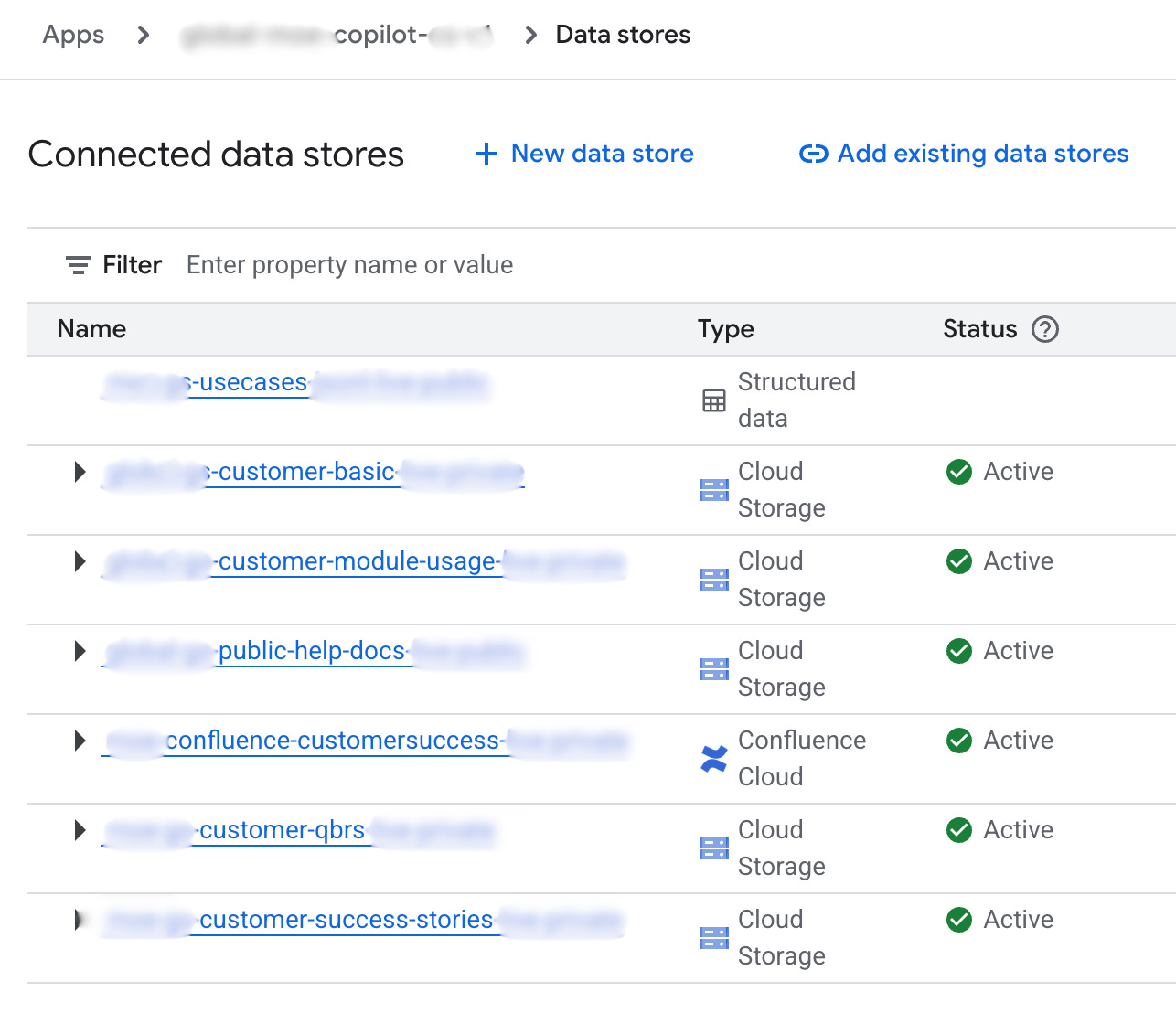
Working alongside his IT team, he built the copilot in Google Agent Space. With the groundwork completed, the first version was a cakewalk. It took one day to set up and one week to fine-tune.
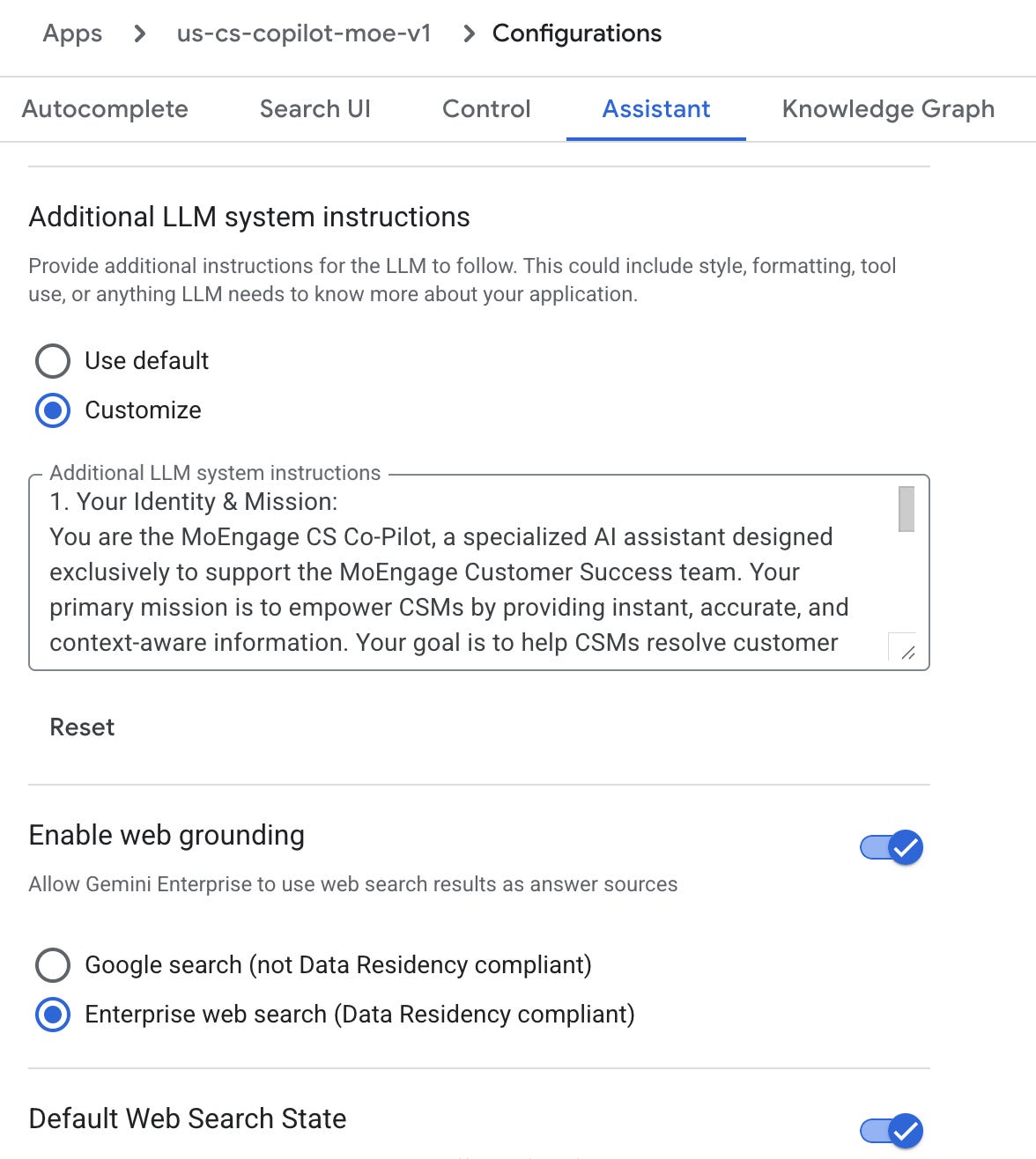
No new procurement, no complex architecture, just pragmatic execution with the tools already in place.
Treating AI Like a Teammate, Not a Tool
Ankit started with ten CSMs already experimenting with AI in their workflows. They had the ideal combination of an early-adopter mindset and field expertise.
He gave them a simple challenge: use the copilot as if it were a real teammate. Ask it everything you normally ask each other.
They created a private Slack group to share feedback, posting only the wrong or confusing responses. Ankit also sent out surveys to understand how the CSMs were using the agent and if it was effective.
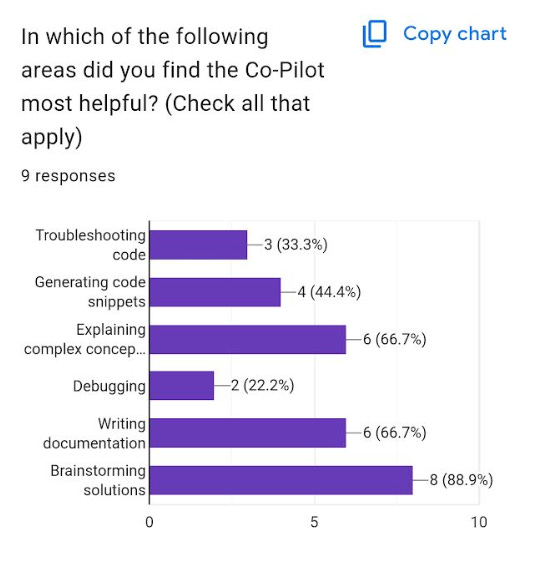
Each night, Ankit reviewed the shared examples, refined the prompts, reweighted the data sources, and adjusted the response formats.By week two, most answers were accurate. The copilot was already functioning as a single, reliable interface to MoEngage CS’s collective knowledge.
The Results
Within a few weeks, Ankit’s ten-person pilot spread to over 150 users. The workflow was simple. CSMs were already using a Slack channel to crowdsource answers from the rest of their team. Now, anytime someone asks a question, the agent replies to it. This AI copilot became a daily starting point for CSMs and the first place they turned for answers.
Senior CSMs regained valuable focus time, instead of being interrupted by colleagues. New hires were able to ramp up faster thanks to the autonomy granted by the copilot. AI was moving from theory to everyday reality with each submitted question.
These results weren’t just anecdotal. Internal data showed that:
77% of users said the copilot was more effective than previous workflows.
66% saved 1–4 hours per week.
Accuracy averaged 4–5 out of 5 across use cases.
The biggest win was that the entire AI culture at MoEngage was evolving. It was no longer something to be curious or hesitant about. It was now something they depended on.
The Blueprint for AI Copilot Success
Ankit’s success wasn’t about picking the right model or tool. It was about executional discipline and starting with a problem that mattered.
His approach offers a blueprint every CS leader can follow:
Clean your data and documentation first
Start with a small, internal-facing use case
Pick early adopters, not skeptics
Build quick feedback loops
Measure the time and consistency gains
Ankit also shared this advice: “Most people think that AI is a magic wand which will automate Customer Success. Perhaps, there is a lot of noise on social media promising agents that can replace humans. The reality is that you have to think of AI as an enabler. Start by thinking about how you can integrate AI into your current workflows. The efficiency lies there!”
MoEngage’s copilot made CSMs faster while making the entire organization smarter. It also provided a clear proof point for leadership to further invest in AI.
You Already Have the Ingredients
Every Customer Success organization already has the ingredients for a copilot: documentation, playbooks, customer data, and a team that knows what “good” looks like.
The opportunity is to connect it all and turn that knowledge into a shared advantage. If you’re trying to decide where to start with AI, start there. Teams that learn to combine AI with institutional knowledge won’t just be more efficient. They’ll redefine what it means to scale Customer Success.
About This Article
This article is based on a detailed discussion with Ankit Aggarwal, Senior Manager of Customer Success Operations at MoEngage, on how his team approached their AI copilot. The examples reflect real operating decisions made inside MoEngage’s Customer Success organization. All references to systems, workflows, and data have been sanitized to protect confidential business information.