![[Un]Churned by Gainsight](https://substackcdn.com/image/fetch/$s_!7AoO!,w_120,h_120,c_fill,f_webp,q_auto:good,fl_progressive:steep/https%3A%2F%2Fsubstack-post-media.s3.amazonaws.com%2Fpublic%2Fimages%2Ffe2167ac-0bcf-4575-9712-8d5ef3588851_300x300.png)
![[Un]Churned by Gainsight](https://substackcdn.com/image/fetch/$s_!hKlf!,e_trim:10:white/e_trim:10:transparent/h_72,c_limit,f_auto,q_auto:good,fl_progressive:steep/https%3A%2F%2Fsubstack-post-media.s3.amazonaws.com%2Fpublic%2Fimages%2Fe14b36dd-52b9-48a3-9f93-3f6a459d55ff_1344x256.png)
![[Un]Churned's avatar](https://substackcdn.com/image/fetch/$s_!vkJ0!,w_108,h_108,c_fill,f_webp,q_auto:good,fl_progressive:steep/https%3A%2F%2Fsubstack-post-media.s3.amazonaws.com%2Fpublic%2Fimages%2F0464ad30-26c2-4f32-b429-ae4283dd5586_200x200.png)

If you lead Customer Success (CS) right now, the last year probably felt like whiplash.
AI went from interesting to unavoidable almost overnight. Boards and executives want outcomes. Teams want clarity. Vendors want urgency. And somewhere in the middle, you are expected to make real decisions without a proven playbook.
Most CS leaders I spoke to described the same tension. Excitement about what AI could unlock, paired with anxiety about expectations, timing, and credibility.
Across dozens of conversations, eleven themes kept repeating. These are the ones that will matter most for CS leaders heading into 2026.
Through my role at Gainsight and as the host of [Un]Churned, I get to spend candid time with CS leaders navigating this shift from the inside. What follows is not a prediction or a checklist you are already late to follow. It is a synthesis of lessons learned by CS leaders the hard way, shared in the hope that 2026 feels more navigable.
1. Leaders Come First
The most effective AI transformations in Customer Success in 2025 did not start with tools, mandates, or roadmaps.
They started with the leader.
Across the CS organizations that made real progress, leaders went first. They carved out time to experiment, learned by doing, and built intuition for how AI behaved inside their workflows before asking their teams to change.
Teams could tell when AI adoption was modeled by leadership versus imposed. Leaders who spoke from firsthand experience earned more trust and discretionary effort. This credibility also showed up in the boardroom too. CS leaders who understood AI deeply earned more latitude because they could clearly articulate what AI could do, what it could not do, and where investment actually made sense.
Two conversations on [Un]Churned stand out.
In my discussion with Colin Slade, SVP of Customer Success at Cloudbeds, he talked openly about carving out intentional time to tinker with AI himself before rolling anything out broadly.
That hands-on learning became the foundation for how Cloudbeds developed over 150 AI and agent workflows in less than a year.
LeeRon Yahalomi, who leads Customer Success at Aligned, shared a similar philosophy when she joined me on the podcast prior. She made space in her own schedule to experiment and learn before asking her team to adapt, setting the tone for change that felt collaborative rather than imposed.
AI transformation in Customer Success does not fail because teams resist change. It fails when leaders try to skip the work of understanding the technology themselves.
2. Beware of ERR: Experimental Recurring Revenue
In SaaS, we anchor on Gross Revenue Retention (GRR) and Net Revenue Retention (NRR) as signals of stability.
What changed is that a growing portion of that revenue became experimental, even if it does not look that way on the surface.
Cassie Young and Kyle Poyar introduced the idea of Experimental Recurring Revenue (ERR) when they joined me on [Un]Churned in December. ERR is revenue that exists because a customer is testing or experimenting, not because they have fully committed.
ERR quietly breaks renewal forecasting, because experimentation looks like commitment until it suddenly does not.
Customers are testing tools under executive pressure to experiment with AI. That phase will end. Vendors will be rationalized.
In this environment, CS teams have to assume every customer is at some level of risk. Even customers who appear healthy. Many are simultaneously evaluating alternatives or building internal solutions through vibe coding tools.
Usage no longer equals commitment.
If you take nothing else from this, audit how your team determines renewal likelihood.
If this reality is not surfaced explicitly, it will show up later in the worst possible place. Renewal forecasts will be wrong, often materially wrong, and almost always in the negative direction.
3. Start Small by Spreading Knowledge First
Starting small does not mean starting slow.
In my conversation with Colin Slade at Cloudbeds, he was candid about an early misstep. Their initial AI efforts took on too much before the organization had built real AI fluency.
What worked better was choosing a simpler starting point.
A theme I saw repeatedly was using AI first to spread knowledge across the CS organization. Instead of jumping straight into autonomous workflows, leaders created a shared, intelligent knowledge layer.
For many, that meant a custom GPT or internal Co Pilot loaded with customer context, CS processes, and product knowledge. Something every CSM could use daily. One leader even purchased his own custom domain for the GPT he created in his own likeness: http://abbasgpt.com.
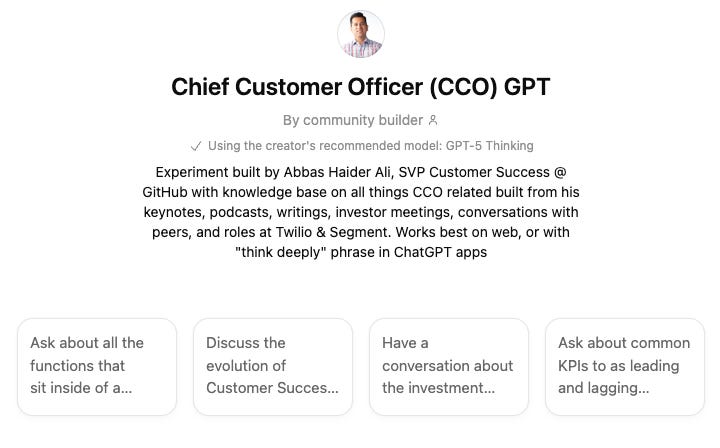
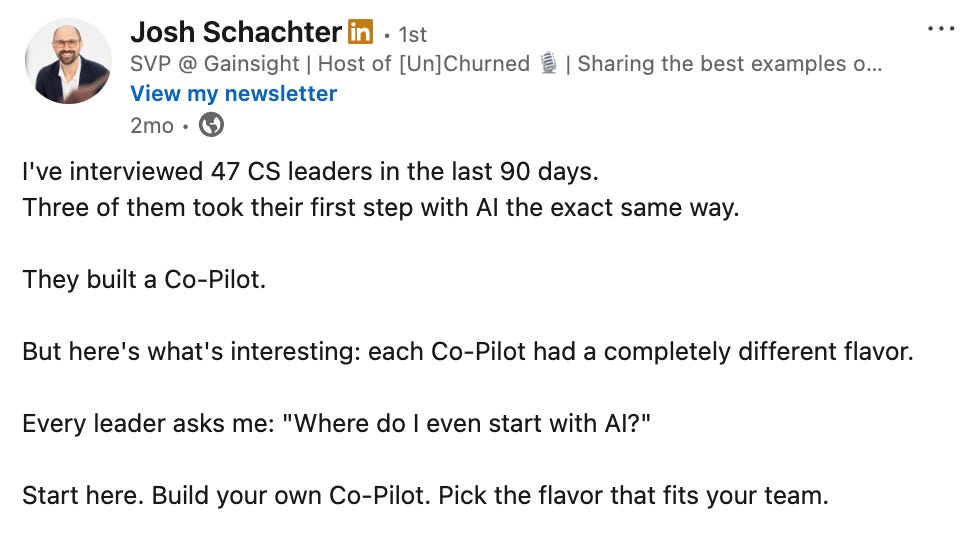
The Co Pilot approach works because it involves everyone, supports existing workflows, and builds confidence without forcing an immediate operating model change. It also creates the foundation for more advanced automation later.
I wrote about this approach in a LinkedIn post on starting with a Co Pilot rather than trying to build an autopilot on Day 1.
Walk before you run.
4. AI Elevates the CSM Only If Customer Conversations Improve
We talk often about AI making Customer Success more strategic.
What gets missed is where that strategy comes from.
AI can only work with the information it has. If conversations stay tactical, insights will stay tactical.
This puts pressure on how CSMs conduct customer conversations.
As AI removes administrative work, the value of live conversations increases. Not more check ins, but better ones. Conversations that surface goals, priorities, constraints, and early signals of change.
That requires skill.
Sales relies on frameworks like MEDDPICC and BANT to ensure signal quality. Customer Success needs its equivalent.
This concept is near and dear to me as the founder of UpdateAI. We built the company to extract meaningful insights from CS conversations because the most valuable signals already existed, but were inconsistently captured or lost.
If your CSMs cannot clearly articulate a customer’s top three priorities, AI will not save you.
Being a strategic CSM does not mean talking more. It means extracting better information.
5. The Rise of the Specialized Generalist CSM
There is an ongoing debate about whether CSMs will become more specialized or more generalized.
Based on the conversations I had throughout 2025, the role is clearly broadening, not narrowing.
Abbas Haider Ali, SVP of Customer Success at GitHub, described this in an upcoming episode of [Un]Churned as the rise of the Specialized Generalist.
As AI takes on more of the tactical and operational execution across onboarding, follow-ups, risk detection, and opportunity surfacing, CSMs are able to own more of the customer journey end to end. In that sense, the role becomes more generalized. Fewer handoffs. Broader accountability. Closer proximity to outcomes.
But that breadth requires a new kind of depth.
The specialization does not disappear. It shifts.
The core specialized skill future CSMs will need is mastery of AI tooling itself. Knowing which tools to use for which situations. Understanding how to prompt effectively. Learning how to train, tune, and validate AI outputs. Developing intuition for when to trust the system and when to intervene.
This is not an accidental skill. It is learned.
For CS leaders, this has very real implications. Hiring profiles need to change. Curiosity, adaptability, and comfort experimenting with tools matter more than rigid functional experience. Enablement needs to focus less on playbook memorization and more on building AI fluency. Coaching needs to reinforce not just customer outcomes, but how effectively CSMs are using and improving their AI tools to achieve them.
The future CSM owns more of the customer than ever before. The leaders who help their teams build depth in AI tooling will unlock that breadth instead of being overwhelmed by it.
6. You Are Behind, But So Is Everyone Else
Many CS leaders feel behind on AI.
That feeling is understandable. Expectations rose faster than playbooks. Executive mandates outpaced proven operating models. And the pace of change made it easy to assume everyone else had already figured something out that you had somehow missed.
What I saw throughout 2025 tells a different story.
There is a small frontier of early adopters already seeing meaningful efficiency and impact. But most CS leaders are still moving together. Experimenting. Learning. Comparing notes. Trying to separate real signal from noise.
I think of it as a peloton.
The pack is still largely intact. That is not a sign of failure. It is a reflection of how new this transition actually is. Most teams are still building fundamentals, not perfecting edge cases.
That said, being behind is understandable. Staying behind will not be.
As the peloton stretches in 2026, separation will start to show. The leaders who move deliberately now, choosing where to focus and where not to chase, will find themselves ahead when AI becomes fully embedded into planning, budgets, and expectations.
CS leaders do not need to panic. But they do need to keep moving with intent.
7. Every Customer Is Now Your Best Customer
For years, many SaaS companies deeply invested in their largest customers and assumed the rest would quietly renew.
Those days are over.
This came up repeatedly, including a conversation I had with Chuck Ganapathi when he first took the helm as CEO of Gainsight back in August.
Customers can buy alternatives or build their own solutions faster than ever. No segment is passive. No customer should be assumed safe.
Scaling care through digital CS, playbooks, and autonomous renewal motions is no longer optional. It is how companies survive heightened churn risk.
8. Schedule AI Like a Team Member
One of the clearest patterns among CS leaders who made real progress was simple.
They protected time.
They treated AI like a team member and scheduled regular time to experiment and learn as part of the workday.
In the same episode I referenced earlier, LeeRon Yahalomi talked about treating time with AI like a one on one when she joined me on [Un]Churned.
AI fluency comes from practice. Leaders who protect time to build it will move faster in 2026.
9. AI Pushes SaaS Toward Outcome Based Models
Outcome based pricing has been long discussed but rarely practical to implement.
Agentic AI changes that.
When outcomes can be delivered end to end, value becomes measurable. Tolerance for under-delivery disappears.
This puts Customer Success at the center of the business model. The CSM becomes a value architect, designing paths to outcomes that matter.
In 2026, outcomes will not just influence pricing models. They will redefine retention. Customer Success will either own that reality, or be exposed by it.
10. Run an AI Hackathon, Even If It Feels Late
AI hackathons may feel passé. They are not.
When done well, they are a leadership signal.
David Karp, former Chief Customer Officer at DISQO, shared his playbook for running an AI hackathon when he joined me on [Un]Churned in September.
The impact was learning compression. Fear dropped. Confidence rose.
For CS leaders, hackathons are a fast way to turn anxiety into action.
11. AI Fluency Does Not Scale Top-Down
One of the most misunderstood parts of AI transformation is where fluency actually comes from.
It does not scale top-down.
It does not come from enablement decks.
And it does not come from a single tool rollout.
In almost every CS organization I spoke to, real progress started at the edges.
There is always someone on the team who is ahead of the curve. Someone experimenting early. Someone building small workflows. Someone figuring out how AI fits into the actual work, not the theoretical roadmap.
The difference between organizations that accelerate and those that stall is what leaders do next.
At Gainsight, one example stands out.
Kalpana Krishna Kumar, Enterprise CSM at Gainsight, shared on [Un]Churned how she used AI to automate large portions of her executive business review prep. The impact was not just time saved. It was proof. Proof that AI could meaningfully change how senior CS work gets done.
That proof matters.
It creates permission. It lowers resistance. It makes the abstract tangible for the rest of the team.
AI capability does not scale through mandates. It scales through example, visibility, and trust.
For CS leaders, this is the reframe.
You do not need to manufacture AI champions. You need to recognize the ones already experimenting and give them room to lead from where they are.
That is often the fastest way to turn individual curiosity into organizational capability.
Looking Ahead to 2026
Across all of these conversations, one shift became clear.
Customer Success is no longer being evaluated on effort or activity. It is being evaluated on outcomes.
2025 was a year of experimentation. With AI, with tooling, with operating models. That experimentation mattered. It created space to learn without immediate judgment.
2026 will be different.
AI is becoming infrastructure. It will shape how companies forecast revenue, assess risk, and decide where to invest. As consolidation accelerates, tolerance for ambiguity will shrink. Assumptions will get tested faster, and signals that once felt good enough will stop holding up.
For CS leaders, the question is no longer whether AI belongs in your organization. That decision is already made. The real question is whether your team is building the capabilities that will matter when experimentation gives way to accountability.
In 2026, CS leaders will be judged less on AI experimentation and more on whether their AI investments measurably improve retention, renewal confidence, and customer outcomes.
Happy New Year.
—Josh

P.S. If you enjoyed this article,
Follow our show in your podcast app so you never miss an episode
SHARE this newsletter so others can learn too
Connect on LinkedIn and give me your unvarnished feedback